AI Vs Traditional Art Understanding The Key Differences
The Creative Process: Human vs Algorithm
Where Inspiration Originates
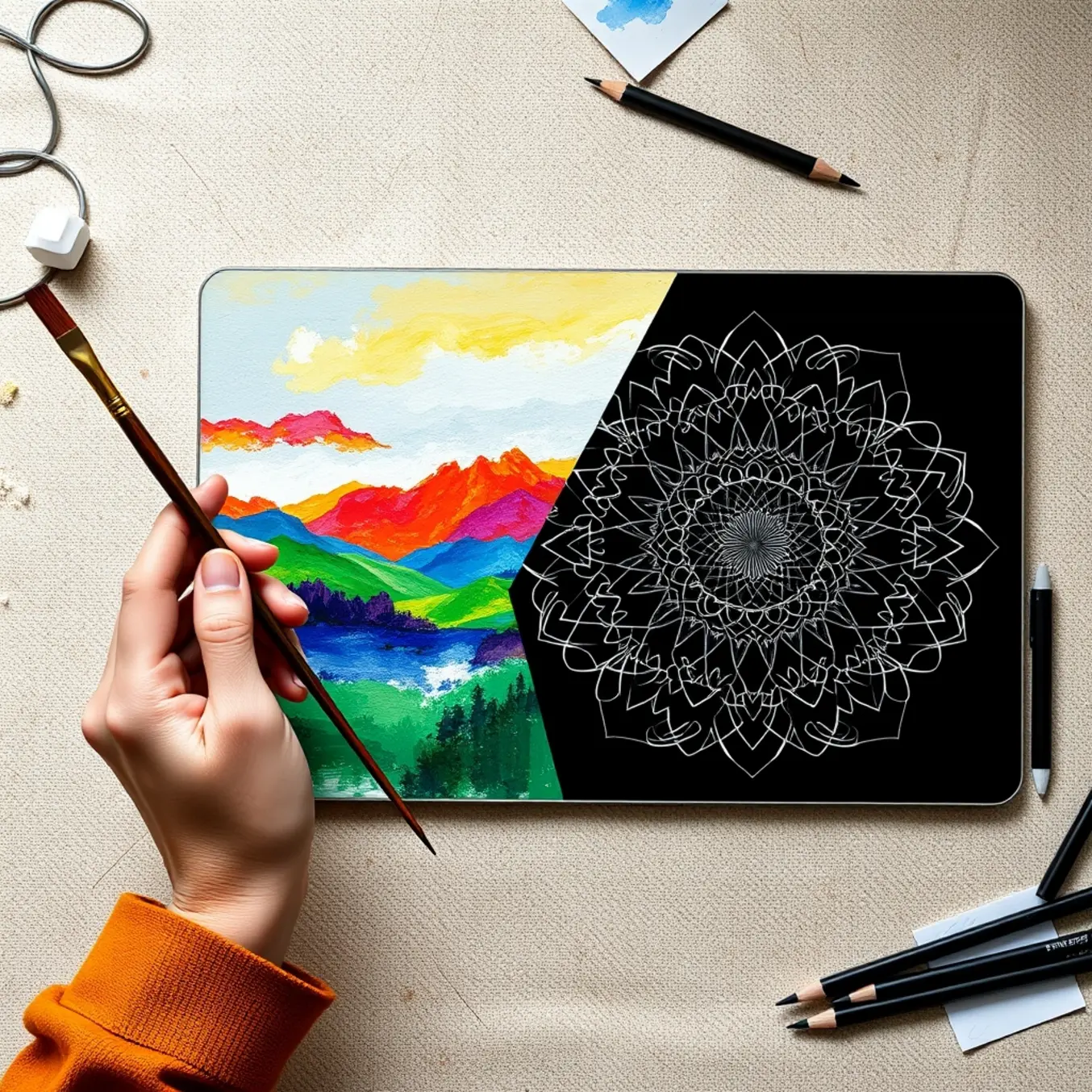
Human creativity begins with lived experience. Artists draw inspiration from emotions, memories, sensory input, and cultural context. This process involves subconscious connections and personal interpretation that shape artistic vision. For example, a painter might translate grief into a specific color palette or composition based on their unique emotional response.
In contrast, AI systems analyze vast datasets of existing artwork. They identify patterns, styles, and compositional rules without emotional context. The algorithm’s “inspiration” comes from statistical probabilities rather than personal experience. This fundamental difference affects how each approaches the blank canvas.
The Role of Intention in Creation
Human artists create with deliberate purpose. Every brushstroke, color choice, and compositional element serves an intentional vision. This conscious decision-making process reflects the artist’s message, technique development, and artistic growth over time. The creative journey itself becomes part of the artwork’s meaning.
AI systems operate without conscious intent. They execute commands based on programmed parameters and training data. While users can provide prompts and guidance, the algorithm itself lacks understanding of why certain elements work together. The result emerges from mathematical processes rather than artistic conviction.
Emotional Connection and Authenticity
Traditional art carries the emotional fingerprint of its creator. Viewers often sense the artist’s passion, struggle, or joy embedded in the work. This emotional resonance creates a bridge between creator and audience that transcends technical skill. The artwork becomes a vessel for shared human experience.
AI-generated art, while visually compelling, lacks this emotional authenticity. The algorithm doesn’t experience frustration, breakthrough moments, or personal investment in the outcome. However, contemporary artists are finding ways to blend both approaches, using AI as a tool within their creative practice while maintaining human emotional direction.
Creative Problem-Solving Approaches
p>Human artists frequently embrace limitations and accidents as creative opportunities. A spilled pigment might inspire a new technique, or a compositional challenge might lead to innovative solutions. This adaptive problem-solving stems from cognitive flexibility and emotional response to the creative process.
AI systems approach problems systematically within their programming constraints. They can generate numerous variations quickly but lack the human capacity for metaphorical thinking or finding meaning in mistakes. The algorithm’s strength lies in pattern recognition and recombination rather than conceptual breakthroughs.
Both approaches offer distinct advantages. Human creativity brings emotional depth and cultural context, while AI provides unprecedented scale and technical variation. Many contemporary artists now integrate AI tools into their workflow, using algorithms to expand their creative possibilities while maintaining human artistic direction. For those interested in exploring this intersection further, our guide to top AI art styles to explore in 2025 showcases how technology is transforming creative expression.
Tools and Techniques: Brushes vs Algorithms
The Physical Toolkit: Traditional Art Materials
Traditional artists rely on a diverse array of physical tools, each requiring specific handling techniques. Brushes made from natural or synthetic hairs create distinct textures, while palette knives allow for thick, impasto applications of paint. The choice of surface—whether stretched canvas, watercolor paper, or wood panel—also significantly impacts the final artwork’s appearance and durability.
Mastering these tools demands extensive practice. For instance, learning to control watercolor requires understanding water-to-pigment ratios and brush pressure. Similarly, oil painting techniques involve managing drying times and layering methods. This hands-on approach develops fine motor skills and a deep, intuitive understanding of material behavior that evolves over years of dedicated practice.
The Digital Toolkit: AI Art Platforms
AI art generation relies on algorithmic tools and platforms that interpret text prompts into visual creations. Leading platforms like Midjourney, DALL-E 3, and Stable Diffusion use sophisticated neural networks trained on vast image datasets. These systems understand complex relationships between words and visual elements, allowing users to generate everything from photorealistic scenes to abstract compositions.
Unlike traditional tools, AI platforms require learning prompt engineering—the skill of crafting descriptive text that guides the algorithm toward desired outcomes. This involves understanding how different platforms interpret specific keywords, artistic styles, and compositional terms. Successful AI artists develop vocabularies that effectively communicate their vision to the machine, often experimenting with multiple iterations to achieve their intended result.
Skill Development Pathways
Traditional art education typically follows a structured progression from fundamental drawing skills to advanced painting techniques. Students learn color theory, perspective, anatomy, and composition through repeated practice and observational drawing. This method builds a foundation of technical skills that can take years to develop but provides artists with complete creative control over their work.
Meanwhile, AI art skills develop through understanding platform capabilities and prompt refinement strategies. Learning involves studying how different AI models respond to various descriptive terms and style references. Many artists combine AI generation with digital editing tools like Photoshop to refine outputs, creating hybrid workflows that leverage both algorithmic creation and human artistic judgment.
Learning Curve Comparison
The learning curve for traditional art is generally steep and prolonged. Basic competency with materials like oils or watercolors can take months to achieve, while mastery often requires decades of dedicated practice. However, this extended learning process builds deep, transferable skills that apply across multiple artistic mediums and styles.
In contrast, AI art platforms offer a much shorter initial learning curve—users can generate compelling images within hours of first using the technology. Yet achieving consistent, high-quality results requires developing sophisticated prompt engineering skills and understanding each platform’s unique capabilities and limitations. The challenge shifts from manual dexterity to conceptual clarity and technical knowledge of AI systems.
Both approaches continue to evolve, with traditional artists incorporating digital tools and AI artists exploring how to develop distinctive personal styles within algorithmic constraints. For those interested in exploring different visual approaches, our guide to top AI art styles to explore in 2025 provides valuable insights into current trends and techniques.
Originality and Authenticity: Who’s the Artist?
The Legal Landscape of AI Art Ownership
The question of who creates an AI-generated artwork—the user providing the prompt or the AI system itself—has become a central legal battleground. Currently, most jurisdictions, including the United States, do not grant copyright protection to works created solely by artificial intelligence. The U.S. Copyright Office has stated that it will only register works created by human beings, emphasizing that “human authorship is a prerequisite.” [Source: U.S. Copyright Office] This creates a significant legal gray area for artists who use AI as a tool in their creative process.
Human vs. Machine: The Authorship Debate
This legal stance fuels a deeper philosophical debate about the nature of artistry. Is the artist the one who conceives the idea, or the one who executes it? In traditional art, these roles are unified in the human artist. With AI, they are often separated. The user provides the creative direction, but the machine generates the final visual output. This challenges our fundamental understanding of what it means to be an author. Some argue that the prompter is the true artist, using the AI as a sophisticated brush. Others contend that without the AI’s generative capacity, the artwork would not exist at all.
Consequently, the perceived value of art is also shifting. Art has historically been valued not just for its aesthetic qualities but for the story of its human creation—the artist’s intention, struggle, and unique touch. As explored in our guide to top AI art styles, the technology can emulate countless techniques, but it cannot replicate a lived human experience. This “aura” of authenticity, a concept famously discussed by philosopher Walter Benjamin, is what many argue is lost in machine-made art, potentially affecting its cultural and monetary worth.
Authenticity in the Age of Algorithmic Creation
Authenticity is intrinsically linked to originality, another concept being tested by AI. AI models are trained on vast datasets of existing human-created art. While they can produce novel combinations, they are fundamentally operating on patterns learned from prior works. This raises concerns about derivative outputs and unintentional plagiarism. An artist’s style, developed over a lifetime of practice and influence, can be analyzed and replicated by an algorithm in moments, blurring the lines between inspiration and infringement.
The Collaborative Future: AI as a Creative Partner
Despite these challenges, many artists are embracing AI not as a replacement, but as a collaborative partner. They use AI to generate initial concepts, overcome creative blocks, or explore visual possibilities at an unprecedented speed, then refine the outputs with their own human skill and vision. In this model, the artist’s role evolves from sole creator to creative director. The final artwork becomes a hybrid, bearing the mark of both human intention and algorithmic execution. This collaborative process may ultimately redefine originality, framing it not as creation from nothing, but as a unique curation and transformation of generated possibilities.
The debate is far from settled. As AI technology continues to advance, our legal systems, art markets, and philosophical definitions will be forced to adapt. The core question remains: in a world where machines can create beauty, what unique value does the human artist bring? The answer may lie not in resisting the technology, but in reasserting the irreplaceable qualities of human consciousness, emotion, and intent in the creative act.
Speed and Accessibility: Democratizing Art Creation
The Time Revolution in Art Creation
Traditional art creation is a notoriously time-intensive process. A single oil painting can require dozens of hours over multiple sessions, while complex digital illustrations might take days or weeks to complete. This significant time investment has historically limited who could practically engage in art creation. However, AI art generators are dramatically compressing these timelines. Users can now produce high-quality, complex images in minutes or even seconds, a process that would take human artists exponentially longer. This acceleration is fundamentally changing the creative workflow, allowing for rapid iteration and experimentation that was previously impractical for most people.
Cost Considerations and Financial Accessibility
The financial barriers to art creation have also been substantially lowered by AI tools. Traditional art supplies—from quality paints and canvases to professional-grade digital tablets and software subscriptions—represent a considerable ongoing expense. In contrast, many AI art platforms offer free tiers or affordable subscription models, making sophisticated art creation accessible without significant financial investment. This democratization means that individuals who previously couldn’t afford art materials can now explore their creativity through digital means. The reduced cost structure is particularly impactful for students, hobbyists, and those in developing regions where art supplies might be prohibitively expensive.
Democratizing Art for Non-Artists
AI art generation is breaking down technical skill barriers that have traditionally separated artists from non-artists. Platforms using natural language interfaces allow anyone with a descriptive idea to create visual art without needing years of training in composition, color theory, or technical execution. This accessibility is empowering diverse voices—from writers visualizing their stories to entrepreneurs creating branding materials—to participate in visual creation. Meanwhile, the emergence of various AI art styles provides users with creative starting points that require no technical expertise to implement.
Impact on Creative Industries
The accessibility of AI art tools is creating both disruption and opportunity across creative industries. On one hand, these tools are enabling small businesses and independent creators to produce professional-quality visuals without hiring expensive designers. On the other hand, professional artists and designers are incorporating AI into their workflows to enhance productivity and explore new creative directions. According to recent industry analysis, many creative professionals now use AI for concept development and initial mockups, reserving their manual skills for final execution and refinement [Source: Forbes]. This hybrid approach represents a significant evolution in how creative work is produced and valued.
The Future of Accessible Creativity
As AI art technology continues to advance, we’re seeing even greater accessibility through mobile applications and simplified interfaces. These developments are making art creation possible for people with physical limitations that might prevent traditional art-making, as well as those with busy schedules who previously couldn’t dedicate time to developing artistic skills. The psychological benefits are also significant—research indicates that engaging in creative activities, even through AI-assisted means, can reduce stress and improve mental wellbeing [Source: American Psychological Association]. This combination of speed, affordability, and ease of use suggests that AI art tools will continue to expand creative participation across global populations.
The Future of Art: Coexistence or Competition?
AI’s Transformative Role in Artistic Workflows
Artificial intelligence is fundamentally reshaping how artists create, iterate, and conceptualize their work. Rather than replacing human creativity, AI tools serve as powerful collaborators that can accelerate tedious processes and unlock new creative possibilities. For instance, AI-powered platforms can generate dozens of visual concepts in minutes, allowing artists to explore directions they might not have considered otherwise.
Many professional artists now incorporate AI into their creative workflows as a brainstorming partner or digital assistant. These tools help overcome creative blocks and provide fresh perspectives while the artist maintains ultimate creative control. According to Art News, numerous contemporary artists are finding that AI enhances rather than diminishes their creative process when used intentionally.
The Enduring Value of Traditional Artistry
Despite technological advancements, traditional art forms continue to hold significant cultural and economic value. The physicality of traditional media—the texture of oil paint, the grain of charcoal on paper, the three-dimensional presence of sculpture—creates an experiential quality that digital art cannot fully replicate. Galleries and collectors still prize original works for their material authenticity and the direct connection to the artist’s hand.
Market data supports this continued relevance. Artsy reports that traditional mediums maintain strong positions in the primary and secondary art markets, with works by living traditional artists achieving record prices at auction. The art world appears to be embracing a both/and approach rather than an either/or dichotomy between traditional and digital creation.
Redefining Art in the Digital Era
The emergence of AI-generated art challenges longstanding definitions of creativity and authorship. These developments raise important questions: Can algorithms be creative? What constitutes original art when machines can produce infinite variations? The art community is actively debating these philosophical questions as AI becomes more sophisticated.
Some institutions are already adapting to this new landscape. The Museum of Modern Art recently featured an AI-generated installation, signaling recognition of digital creativity as a legitimate artistic medium. Meanwhile, new categories like AI art styles are emerging as distinct genres with their own aesthetic principles and technical considerations.
Collaborative Futures: Human and Machine Creativity
The most promising path forward appears to be collaboration rather than competition. Many forward-thinking artists are exploring hybrid approaches that combine traditional techniques with AI augmentation. This might involve using AI to generate initial concepts that are then refined through physical media, or incorporating digital elements into traditional artworks.
Educational institutions are beginning to reflect this integrated approach. ArtCenter College of Design has developed curriculum that teaches students to work alongside AI tools while developing their fundamental artistic skills. This balanced approach prepares emerging artists for a future where technological fluency and traditional craftsmanship coexist.
As the boundaries between human and machine creativity continue to blur, the art world is evolving toward a more inclusive definition of artistry—one that values intention, conceptual depth, and emotional resonance regardless of the tools used to achieve them.
Sources
- American Psychological Association – Nurtured by creativity
- ArtCenter College of Design – AI at ArtCenter
- Art News – AI Art: Artists Reactions
- Artsy – Why Traditional Art Still Matters in the Digital Age
- Forbes – The AI Art Revolution: Everything You Need To Know About Text-To-Image Generators
- Museum of Modern Art – Reframing Art History
- U.S. Copyright Office – Copyright Registration Guidance: Works Containing Material Generated by Artificial Intelligence