The Ultimate Guide To Crafting Fantasy AI Art Prompts
The Anatomy of a Perfect Fantasy Prompt
Creating compelling fantasy AI art requires understanding the fundamental building blocks that transform vague ideas into vivid visual masterpieces. While AI art generators like Midjourney and Stable Diffusion can produce stunning results, they rely heavily on well-structured prompts to deliver exactly what you envision. The most successful fantasy prompts typically include several key components working together to guide the AI toward your creative vision.
Subject and Character Description
Every great fantasy prompt begins with a clear subject. Instead of simply writing “a warrior,” specify details like “an elven ranger with silver hair and emerald eyes, wearing intricately carved leather armor.” Research from AI prompt engineering studies shows that detailed character descriptions significantly improve output quality. Include physical attributes, clothing, weapons, and emotional state to give the AI concrete visual elements to work with.
Setting and Environment Details
The environment establishes the mood and context for your fantasy scene. Describe not just locations but atmospheric conditions—”a mist-shrouded ancient forest with bioluminescent fungi” creates a more evocative image than simply “a forest.” According to DALL-E 3 documentation, environmental details help the AI understand spatial relationships and lighting conditions. Consider including time of day, weather, architectural styles, and natural features to build immersive worlds.
Art Style and Medium Specifications
Specifying artistic style dramatically influences the final output. Terms like “digital painting,” “oil on canvas,” “concept art,” or “watercolor illustration” guide the AI’s rendering approach. For those exploring different visual approaches, our guide to top AI art styles to explore in 2025 offers comprehensive style references. Additionally, referencing specific artists or art movements can further refine the aesthetic direction.
Lighting and Atmosphere Elements
Lighting descriptions transform static scenes into dynamic compositions. Terms like “cinematic lighting,” “volumetric fog,” “golden hour sunlight,” or “moonlit” establish mood and depth. A recent study on AI image generation found that lighting cues significantly impact perceived image quality and emotional resonance. Combine lighting with atmospheric effects like “swirling magical energy” or “ethereal glow” to enhance the fantasy elements.
Technical Parameters and Composition
Beyond descriptive elements, technical parameters help fine-tune the output. Include camera angles (“low-angle shot,” “aerial view”), composition terms (“rule of thirds,” “symmetrical composition”), and aspect ratios. Many AI art platforms also respond to quality modifiers like “highly detailed,” “sharp focus,” or “8K resolution” to elevate the final image’s polish and clarity.
Crafting Cohesive Fantasy Narratives
The most successful fantasy prompts tell a miniature story through visual elements. Instead of listing disconnected features, weave them into a coherent narrative: “A battle-weary dwarf blacksmith examines a glowing rune-etched hammer in his torchlit underground forge, surrounded by intricate mechanical contraptions and steaming magma channels.” This approach gives the AI contextual relationships between elements rather than treating them as separate components.
Furthermore, balance specificity with creative freedom. While detailed prompts yield more precise results, leaving some elements open to interpretation can produce surprising and inspired creations. The emerging research on human-AI creative collaboration suggests that the most satisfying outcomes often come from this balanced approach—providing clear direction while allowing the AI to contribute its own artistic interpretation.
Character Creation Prompts: Heroes, Villains & Creatures
Hero Creation Prompts
Creating compelling heroes requires balancing strengths with relatable flaws. Start with a clear archetype—like the reluctant farmhand destined for greatness or the grizzled veteran seeking redemption. Then, layer in unique magical abilities, personal motivations, and moral dilemmas that challenge their core beliefs.
For example: “A young herbalist discovers she can communicate with ancient forest spirits, forcing her to defend her village against industrial expansion that threatens both human and magical realms.” This prompt establishes clear stakes while allowing room for internal conflict.
When designing heroes, consider their visual appearance carefully. Different AI art styles can dramatically alter how your character is perceived—from photorealistic warriors to stylized anime protagonists.
Hero Prompt Examples
- “A knight who swore an oath of pacifism must protect refugees using only defensive magic and clever tactics”
- “An aging scholar becomes the unexpected guardian of a dangerous magical artifact everyone wants”
- “A street urchin with the rare ability to manipulate shadows rises to lead a rebellion”
Villain Creation Prompts
Memorable villains believe they’re the hero of their own story. The most compelling antagonists have understandable motivations twisted by trauma, ideology, or desperation. Research shows that villains with sympathetic backstories create deeper narrative tension and moral complexity.
Consider: “A former healer who lost their family to plague now seeks to ‘purify’ the world through extreme measures, viewing themselves as a necessary evil.” This approach creates villains that challenge both the hero and the audience’s moral compass.
Visual design plays a crucial role in villain presentation. Their appearance should reflect their corruption—perhaps through subtle physical changes or dramatic transformations that showcase their descent into darkness.
Villain Prompt Examples
- “A revolutionary leader whose methods grow increasingly tyrannical as their cause advances”
- “A celestial being who believes mortal freedom causes more suffering than orderly control”
- “A spymaster manipulating kingdoms into war to prevent a prophesied apocalypse only they know about”
Creature & Mythical Being Prompts
Fantasy creatures should feel both wondrous and biologically plausible. Start by combining unexpected animal traits with magical elements, then consider how they fit into their ecosystem. According to creature design experts, successful designs often feature clear silhouettes and functional anatomy that suggests how the creature moves and survives.
For instance: “A crystalline deer whose antlers grow glowing mushrooms that can heal or poison, depending on the phase of the moon.” This creates visual interest while establishing practical uses within your world.
Mythical beings like gods, spirits, and elementals should embody the concepts they represent. Their appearance and abilities should directly reflect their domain and personality, creating immediate visual storytelling.
Creature Prompt Examples
- “Flying serpents that migrate through storm clouds, their scales changing color with atmospheric pressure”
- “Stone golems animated by trapped earth spirits, slowly crumbling as they fulfill their ancient purpose”
- “Shape-shifting river spirits that appear as beautiful humans but drown those who disrespect their waters”
Advanced Character Development Techniques
Once you have basic character concepts, deepen them with conflicting motivations and growth arcs. Studies in narrative psychology show that characters facing impossible choices between competing values create the most engaging stories.
Consider giving heroes flaws that directly challenge their goals, or villains redeeming qualities that make their actions more tragic. For example, a thief with a strict moral code about who they rob, or a cruel dictator who genuinely loves their family.
Remember that the most memorable characters often subvert expectations while remaining internally consistent. Their designs, abilities, and personalities should all work together to create a cohesive and intriguing presence in your fantasy world.
World-Building Prompts: Landscapes & Environments
Creating Enchanted Forests That Breathe
Enchanted forests serve as the living heart of many fantasy worlds, where every tree and creature tells a story. To create a truly immersive woodland realm, consider giving the forest its own consciousness and purpose. What if the trees communicate through bioluminescent patterns at night? Or what if ancient spirits inhabit specific groves, granting blessings or curses to travelers? These elements transform a simple forest into a character with agency and history.
Meanwhile, the ecosystem within your enchanted forest should follow its own magical logic. Perhaps certain plants only bloom under moonlight, or animals possess the ability to phase between dimensions. Consider how magic has altered the food chain—maybe predators hunt using illusions rather than physical strength. This approach creates a cohesive environment where every element feels intentionally designed rather than randomly placed.
Designing Floating Cities With Structural Logic
Floating cities present unique world-building challenges that require creative solutions for suspension and society. The method of levitation often defines the city’s culture and limitations. Is the city held aloft by ancient crystals that require regular maintenance? Or perhaps it floats on captured clouds that slowly dissipate over time, creating urgency for resource management. These mechanics naturally generate plot points and cultural practices.
Transportation between the ground and your floating city reveals much about its social structure. Wealthy residents might use personal flying mounts, while commoners rely on dangerous rope lifts or temperamental teleportation circles. The city’s relationship with the surface world below—whether it’s exploitative, protective, or completely isolated—adds depth to political dynamics and creates natural conflicts.
Crafting Dynamic Environmental Systems
Fantasy environments feel most authentic when they operate as interconnected systems rather than static backdrops. Consider how magic affects weather patterns—does a permanent aurora borealis provide constant twilight in certain regions? How do magical energies alter seasonal changes? A desert that experiences crystalline snowstorms or a jungle where rain falls upward creates memorable, distinctive landscapes.
The inhabitants of your world should reflect their environment’s unique properties. In a realm with floating islands, cultures might develop exceptional climbing skills or wing-based transportation. Societies in constantly shifting landscapes would likely become nomadic, with architecture designed for easy disassembly and transport. These adaptations make your world feel lived-in and logically consistent.
For creators looking to visualize these environments, exploring different AI art styles can provide inspiration for translating written descriptions into visual concepts. The right artistic approach can help refine the mood and aesthetic of your imagined landscapes.
Establishing Environmental History and Consequences
Every landscape tells a story of its past, and fantasy environments often bear scars of magical cataclysms or divine interventions. A forest might grow in spiral patterns because of an ancient dragon’s death spiral, or mountains could be arranged in perfect geometric shapes from a wizard’s failed experiment. These historical events provide explanation for unusual geography while offering plot hooks for exploration.
Environmental consequences create compelling limitations for your characters. In a city built among giant mushrooms, certain areas might be restricted during spore-release seasons. A desert with sentient sandstorms could require specific magical protections for travel. These natural challenges force characters to adapt and problem-solve, making the environment an active participant in your narrative rather than passive scenery.
According to world-building experts at Mythcreants, the most memorable settings often have “one big lie”—a single magical element that logically extends through every aspect of the environment. This consistency helps audiences suspend disbelief while enjoying the fantastic elements of your world.
Magic & Spell Effects Prompts
Creating Glowing Runes and Arcane Symbols
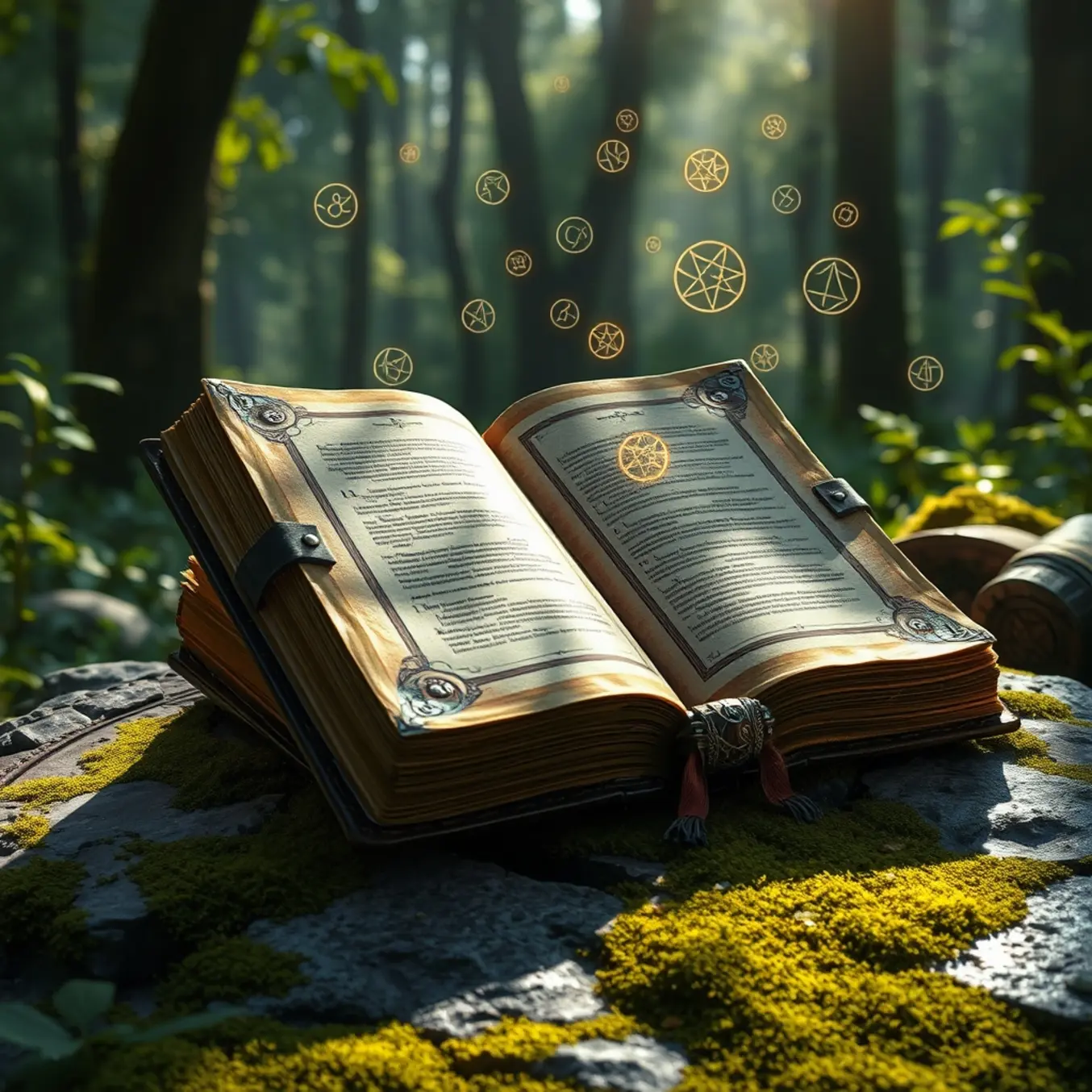
Glowing runes represent one of the most captivating magical effects to generate with AI. These ancient symbols can appear carved into stone, floating in mid-air, or etched onto magical artifacts. To create convincing runic designs, specify the material surface, lighting conditions, and the intensity of the magical glow. For instance, “ancient Norse runes glowing with blue ethereal light on weathered stone” produces dramatically different results than “golden elvish script floating in a dark forest clearing.”
The positioning and arrangement of runes significantly impact the magical atmosphere. Circular arrangements often suggest protective wards or containment spells, while linear sequences might indicate activation sequences or communication symbols. Adding motion descriptors like “pulsing rhythmically” or “slowly rotating” brings additional dynamism to these magical elements. Meanwhile, color choices carry symbolic meaning—blue for mystical knowledge, green for nature magic, or crimson for forbidden arts.
Crafting Spellcasting Visual Effects
Spellcasting moments benefit tremendously from specific visual descriptors that capture the energy and nature of magical forces. Elemental spells require distinct characteristics: fire magic might involve “swirling vortexes of orange and red flames coalescing around the caster’s hands,” while ice magic could feature “crystalline structures forming from condensed moisture in the air.” The scale of the effect matters enormously—are you creating a subtle charm or a cataclysmic incantation?
Consider incorporating multiple sensory elements beyond pure visual description. Phrases like “crackling with arcane energy” or “humming with magical power” suggest auditory components that enhance realism. The spell’s origin point—whether emanating from a wizard’s staff, a sorcerer’s fingertips, or an ancient relic—determines the flow and direction of magical energies. Additionally, the spell’s purpose (healing, destruction, protection) should inform its visual characteristics, with gentle golden light for benevolent magic and jagged, dark energy for offensive spells.
Atmospheric and Environmental Magic
Magic shouldn’t exist in isolation—it interacts with and transforms its surroundings. Environmental magic effects create immersive scenes where the very atmosphere responds to supernatural forces. Descriptors like “magical energy causing the air to shimmer with heat haze distortion” or “levitating rocks surrounded by glowing particles” establish that the magic affects physical reality. These background elements provide context that makes primary spell effects more believable and integrated.
Weather manipulation offers particularly dramatic possibilities for magical scenes. Storms summoned by magic might feature “unnaturally green lightning forks across a violet sky” or “torrential rain that falls upward instead of downward.” Time-of-day considerations further enhance these effects—magic visible at night benefits from contrast against darkness, while daylight magic might appear as “brilliant prismatic light refracting through morning mist.” The environment’s reaction to magic, such as “grass withering where dark energy touches it” or “flowers blooming instantly in the wake of healing magic,” tells a story beyond the immediate visual effect.
For those exploring different artistic approaches to magical themes, our guide to top AI art styles to explore in 2025 provides valuable insights into stylistic choices that can make your magical creations stand out.
Advanced Prompt Engineering for Complex Magic
Layering multiple magical elements creates sophisticated scenes that tell richer stories. Combine different effect types—”a protective dome of interlocking runes while energy tendrils lash out toward attackers”—to show magic serving multiple purposes simultaneously. Specify interaction between magical elements, such as “ice magic extinguishing fire spells upon contact” or “healing energy causing necrotic magic to recoil.” These relationships make the magic feel like part of a coherent system rather than disconnected visual effects.
Progression and transformation effects demonstrate magic as an active force. Descriptors like “the magic slowly building from a faint glow to an intense blaze” or “the spell causing the target to transform gradually” create narrative tension and visual interest. Research from AI image generation studies shows that temporal descriptors significantly improve result quality for dynamic scenes. The materialization and dematerialization of magical effects—whether something appears instantly or fades into existence—also dramatically impacts the perceived nature of the magic.
Finally, don’t overlook the importance of perspective and composition in magical scenes. Low-angle shots looking up at towering magical constructs create awe, while close-ups on intricate spell details emphasize precision and complexity. The viewpoint character’s relationship to the magic—are they controlling it, threatened by it, or observing it—should inform both the visual treatment and the emotional impact of your generated artwork.
Advanced Techniques: Style Modifiers & Artist References
Mastering Style Modifiers for Distinctive AI Art
Style modifiers are specific keywords that instruct AI art generators to apply particular aesthetic qualities to your creations. These powerful tools transform generic prompts into visually compelling artwork by defining everything from color palettes to texture and composition. For example, adding “impressionistic” creates soft, blurred edges and visible brushstrokes, while “cyberpunk” generates neon-lit urban landscapes with futuristic elements.
Effective style modifiers work by referencing established art movements and visual traditions that AI models have been trained on. When you specify “art nouveau,” the AI draws from its knowledge of flowing organic lines and natural forms characteristic of that period. Similarly, “surrealism” prompts the model to create dreamlike, unexpected juxtapositions and illogical scenes. The key is selecting modifiers that align with your creative vision while being specific enough to guide the AI effectively.
Leveraging Artist References for Authentic Style Replication
Referencing specific artists in your prompts allows you to tap directly into distinctive visual styles that AI models have learned during training. When you include “in the style of Van Gogh,” the generator applies his characteristic swirling brushstrokes and expressive color choices. Mentioning “inspired by H.R. Giger” produces biomechanical horror aesthetics with organic-mechanical fusion.
This technique works because AI art models have been trained on millions of artworks labeled with artist attributions. The system learns to associate certain visual patterns, techniques, and compositional choices with specific creators.